
This is Not A Hamantaschen
Things they never taught you in Hebrew School

This Monday night and Tuesday we celebrate Purim. What’s the holiday about?
Well, most people will answer with some variety of how we jokingly sum up most Jewish holidays:
“They tried to kill us, we survived, let’s eat.”
And what are we going to eat?
Triangle fruit-filled cookies most people call Hamantaschen. Google around and you’ll find article after article that traces these cookies to “montaschen” – poppy cookies eaten by German Jews in the 18th century or Oznay Haman, “Ears of Haman” mentioned in an Italian Purim play in the 16th century.
In the Ivri Way we read what the mystics call White Fire Torah as well as Black Fire Torah:
Black Fire Torah is the ink of the page that lays out the narrative.
White Fire Torah is composed of the negative shapes around each ink letter. It is non-obvious Torah, suppressed Torah, mystical Torah—in the words of the Kedushat Levi (Likutim 174) a more elevated Torah, and in the teachings of Reb Zalman, the Torah of silenced female voices.
When you look at Purim from a White Fire Torah lens, a very different story than “they tried to kill us, we survived, let’s eat” emerges.
In the Talmud it says (Chullin 139b):
Where in the Torah can one find an allusion to the events involving Esther?
“And I, [the Divine,] will surely hide/haster astir My face.” (Deut 31:18)
The sages link the word “hidden”--haster--with its near homophone Esther.
The 19th century mystic Rav Tzadok HaKohen of Lublin echoes many Kabbalists when he says (Pri Tzedek Purim 4):
This hiddenness is the very essence of Purim.
And what element of the Divine is being concealed in this holiday?
Historians notice that the names of the characters in the story of Purim have unfamiliar echoes—-the good guy Mordechai? Sounds a lot like the Persian god Marduk. Haman? The Elamite god Humman. Vashti? The goddess Mashti.
And the main character, the heroine Queen Esther?
Ishtar, the ancient Mesopotamian fertility goddess.
Also known by our ancestors’ ancestors, the Sumerian families Sarah and Abraham probably came from, as fertility Goddess Inanna. Which literally means Lady of Heaven, or, in Hebrew, Malqat HaShamayim, Queen of Heaven.
And how does one show devotion to the feminine Divine, the sacred aspect of fertility?
Our ancestors tell us.
They worshiped the feminine face of the Divine, the energy of fertility, with
KAVANIM (singular Kavan)
cookies made in Her image
(Jeremiah 44:19)
Take a good look at this cookie:
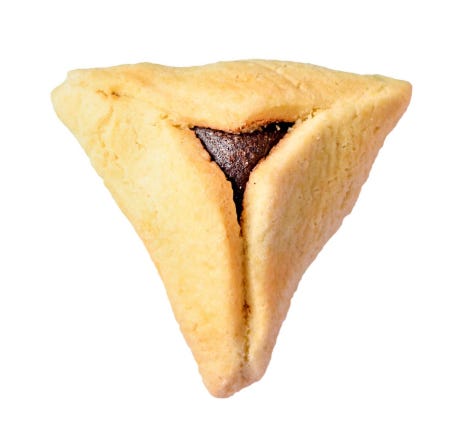
What body part does this most resemble?
An ear? You see Haman’s ear?!
I don’t seen an ear. I see what we sometimes call the Makom, or to get more detailed, what 16th century mystical master Rabbi Moshe Cordovero called...
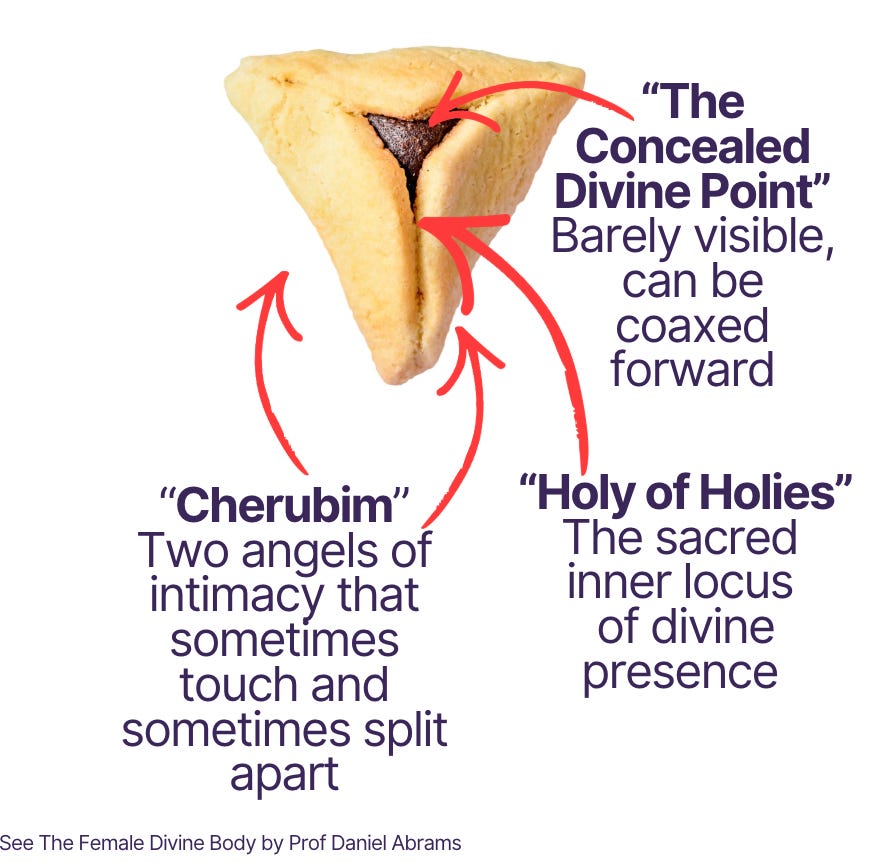
This is a cookie “made in Her image,” a holy cookie that has echoes at least 3,000 years old, made, knowingly or not, in the shape of sacred fertility.
I am among those who believe that the story of Esther is a Purim mask, a covering for what is haster astir, “surely hidden,” an older, wilder holy day of revelry, feasting, dancing, and disguise, a celebration of the feminine Divine power of fertility emerging from winter’s long concealment, returning in the beauty and lush abundance of spring. After King Josiah criminalized our native worship of the Divine feminine, perhaps this holiday transmuted into the story of the Book of Esther, the Divine feminine hidden within a more acceptable narrative.
But not too hidden---in the Talmud 2nd century sage Rabbi Nechemia says quite plainly (Meg 13a):
Why was the [protagonist of the Purim story] called Esther? All peoples called her so after Ishtar.
When our medieval ancestors started making these cookies, they might not have consciously understood what their hands were forming, but the motions of forming this sacred shape were awakened deep deep in their DNA.
So yes, it is valid to celebrate Purim as a story of terror, trauma, and triumph. There is important healing and sacred truth there.
But if you’re looking for something else, something perhaps even older and more nourishing in this spiritual wilderness we find ourselves in, I invite you to “vinahafoch hu”--turn everything upside down:
Flip patriarchy on its head.
Upend dominating stories of victimhood and oppression.
Embrace the wild wondrous power of Malkat HaShamayim, our Queen who art in Heaven, the energy of all fertility and life, the feminine face of the One.
Savor the joy of being alive in your beautiful living body.
Dress in your sacred feminine best.
Pour out a drink for the One.
And please, for the love of Goddess: Reject dry and tasteless hamantaschen. Find yourself a tasty and delicate kavan, and eat it as reverentially, as slowly, and as sensually as you can.
Ken tehe ritzona
May it be Her will
Want to go deeper? We’re offering a Queen of Heaven ceremony in Brooklyn on March 2--RSVP, get tickets, and more info here!
Beautifully written. The whole story is also clearly about suppressed feminism.
This is everything I've ever wanted in an essay on Purim. Thank you, thank you, thank you, in the name of our Queen of Heaven.