
The Mother Wound
-first aid-

My mother was not a great mother for me. Better than some mothers, sure, worse than others. But she set herself up for an impossible job. She said love was like a flame that could light many candles without diminishing. That might be true, but what kind of love were we talking about? Love in the abstract? Sure. You can love the whole wide world. But a mother’s love? That’s less elastic. There are limits on how many people you can successfully mother at a time. I was my mother’s fifth child. She had six more after me, one every two years. That’s too many.
She provided some basics: delicious homemade food, laundered (if stained and hand-me-down) clothing. When she hit me and pinched me it was painful but never hard enough to leave a mark. She knew I loved to draw and one year she arranged for me to take art lessons. When I was fourteen and things were starting to turn, on Shabbos afternoons she let me come sit beside her as she rested in her dark bedroom, giving me some time to talk to her.
But she was not a warm person. She was not affectionate. When she made up her mind, it could not be changed. At twelve years old, I was sent to sleepaway camp for the first time. I went as a mother’s-helper, so I could go for free. I worked half the day and was with my bunk the rest of the time. The other girls thought I was strange, weird, poor. It was a fair assessment. I did not make any friends. I cried on the phone, begging to come home. It was useless. My mother had signed me up for eight weeks. I would stay the full eight weeks.
My mother could say “I loo loo” like a baby, when she supervised us saying our evening prayers, but she did not seem able to say “I love you.” She would hug us when we came home from a long trip, but not otherwise. She did not express concern that I had failed, socially. She did not seem concerned that I spent most of my childhood alone, down at the bottom of a pool of deep depression. In our house, she was often overwhelmed by the chaos of the children. When it got too loud, too much, she’d escape to her room and lock the door, leaving us at the mercy of whichever child was oldest, strongest, most violent.
And that was before I began to sin. Before I protested my father’s racism, before I told my mother I wanted to go to college, before I was caught talking to a boy. When that happened, everything changed. Or, everything stayed the same– she was who she had been, only more so.
Living in Jerusalem, I bought a sweater that was too tight to be modest and she cut off my living allowance. Back in the US at seventeen, friendless, lost, I asked her what would happen if I slept with a non-Jew, if she’d sit shiva for me. She said yes. She asked no follow up questions. Why was I asking this? What was going on in my life, alone in New York City? She didn’t seem curious or concerned.
When I was assaulted, I did not tell her. Our relationship was almost non-existent, but I did not want her to sit shiva for me. I knew it wouldn’t matter that I had said no, that I hadn’t wanted it. Eventually, I told my brother. He told her. He told me that it was upsetting for her to hear, because she was supposed to go to the ritual bath that night. A prelude to intimacy with my father. Perhaps my mother had some other response that she said to my brother, but that was the only thing he told me. Why was she telling my brother that the news of my assault was going to throw a wrench in her intimate life? She never spoke to me about any of it.
At some point she told me she thought I was possessed by a dybbuk. That was how she understood me. She’d hang the phone up on me if I ever tried to tell her what happened after she and my father cut me off.
Ten years ago, I got her on the phone. I told her that I’d been abused as a child. I didn’t tell her by who. Just that it had happened. I think I hoped that I was handing her a key, some way to reconfigure who I had been, not a sinner bizarrely possessed by an evil spirit but a child who had been harmed at a young age.
She was silent for a long time.
Finally she said: “It’s unspeakable.”
That was all she said.
A few weeks later I wrote her a letter filled with apologies for all of the ways I hurt her. I told her, in the most gentle of terms, how some of her choices had hurt me. I said: I want to have a relationship with you, but we can’t have a relationship unless we can talk about this. She never responded.
And now it’s Mother’s Day again. Comes around every year. My partner woke with the kids so I could sleep. I dreamt of a child clinging to the edge of a bridge. People were trying to rescue the child. I was tempted to keep going, but I stopped. I crouched down beside the child. I held the child’s hand. We got the child to safety. We cleaned them up. We were talking about how we’d get the child the care it needed, when suddenly, we heard a scream. The child’s hands had snapped off.
My children came and snuggled beside me in bed. My fourteen year old, with mermaid green hair, sparkling blue eyes, and the wisest, sweetest heart in the world. My seven year old, bouncing around the room, nuzzling my face, schlepping the cat over, bubbling with excitement to tell me about the new robot he’d been building. These two humans are magnificent.
I’m nonbinary and I introduce myself as my kids’ parent, not mother. But to my kids, I am their mother. I came out after my daughter was born. I couldn’t take her Mama away. Still, she mourns who I used to be. She wishes I could be like other girls’ moms—into makeup and fashion and girly stuff. But I have also fallen short in much more serious ways. With her and with my son.
That was one of the hardest lessons of my life. Perhaps the hardest. Realizing that my determination not to mother like my mother, not to hurt my kids the way she and my father had hurt me, was not enough to prevent me from causing harm. That when I have been seriously ill or stressed, my mother’s ghost has risen in me, emerged from me, lashed out at my kids. My mother’s ghost, I say. As if it was her fault. But as a parent, you don’t get to point the finger. The buck stops with you. I was the one who said the things I regret. I was the one who failed my children at different crucial moments.
I wonder if my mother had the ghost of her own mother in her. She wasn’t close with my grandmother. My grandmother was a bitter woman, shriveled with grief after the sudden death of her husband at the age of forty five. Did she shout at my mother? Did she say the things my mother said to me? And did my grandmother’s anger take the shape of her mother before her, my great-grandmother, an immigrant from Lithuania who left behind siblings shot by their neighbors while holding their babies in their arms and then buried alive?
I go outside for a breath, sit on the stoop. The sun is out. A city bus rumbles by. A breeze tickles the thick green leaves of the trees that line the block. The air all around is rich with oxygen. It’s filled with the sweet aroma of the city after a springtime rain.
They’re our mothers, I know. These trees. Even these ones in Brooklyn spaced across the concrete, little cages around their trunks. They nurse us with their oxygen every day of our life. Our ancestors understood this, saw the way trees care for us, saw them as a portal to the Great Mother. Asherah, they called Her. Fortunate One.
I feel fortunate for the mothering of these trees. I feel fortunate for the mothering of my mothers, the rivulets of kindness that slipped around the pain. I feel fortunate for the ancient mothers who used to be stronger, bigger, kinder, before they were devastated by patriarchy.
I’ve been motherless now longer than I’ve had a mother. In parenting my own children, I’ve halted some of the cascade of harm that wanted to pour through me. I have refused it. I have healed it. I have wrestled with it.
I hope my children will mother their children with whatever care and tenderness I have mothered them, and with less of my missteps. I hope generation by generation we heal the mother wound. I hope we transform that wound into a portal, no longer raw, no longer weeping pain, but instead a channel of mother blessing.
The child without a mother is still within me. Sometimes they’re at the edge of the bridge, crying out. I try to hold their hand. Sometimes, life comes at me too fast, someone pushes on the injury. I lose the child. I become the pain.
I used to think my goal was to never become my mother, to release her hold on me. Anything less felt like failure. But now I think the goal is something harder, something more complex. Now I think what I’m trying to do is to learn how to hold grief and love in the same hands. To learn how to love imperfectly. To keep reaching for the hand of the child within me, even if I lose it sometimes. To keep reaching for my children’s hands, even if I fumble sometimes. To keep reaching for the hand of the Great Mother, who holds me always.
Wherever this Mother’s Day finds you—in the wound or in the portal, wracked with pain or filled with gratitude, I send you care. I send you tenderness. I sit with you, breathing deep the love of our Mother Tree. I send you blessings of good, kind, wise motherly love.
Ken teheye ritzona
May it be Her will
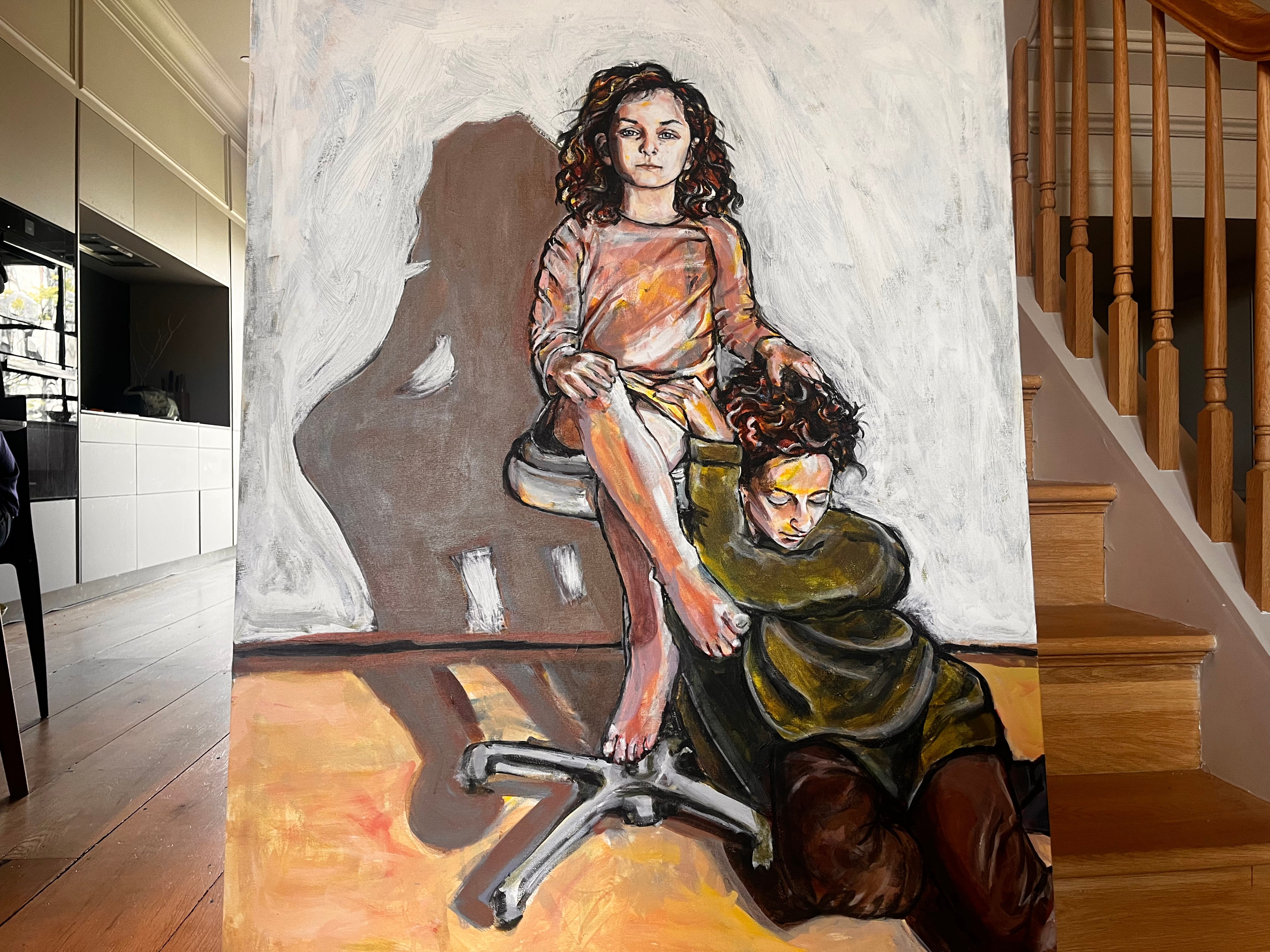
Me and my kiddo awhile back
Very Moving
This touched me so deeply...all the layers we hold in relationship to our moms....
It's wild the way the grief stays in our being--despite decades of therapy, and compassion for her circumstances, and a deep desire not to hold onto all the pain of my ancestors.
That yearning for my mom, it goes to the depths of my being--even in middle age. Thank you for your beautiful writing, it captured what so many of us feel.